


01 November | 2 MIN READ
Teamcenter PLM: The Key to Productivity and Traceability
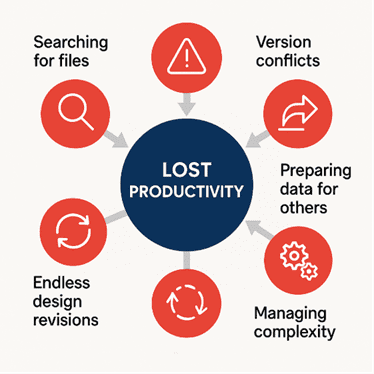
In today’s fast-paced environment, where teams are overloaded, systems don’t talk to each other, and design revisions feel endless, it’s easy to lose control. IT, engineering, and executive teams know the challenge well, they need agility, control, and traceability. But when your experts spend their day searching for files, managing version conflicts, or repeating poorly documented tasks, innovation stalls and competitiveness fades.
Find out the top 5 time-wasting tasks that drain engineering productivity.
Why Companies Lose Productivity Without a PLM System
According to Tech-Clarity, engineers can lose up to 25% of their time on low-value tasks such as locating data, managing document versions, or redoing poorly documented work. These inefficiencies don’t just impact engineering, they place a heavy burden on IT too, who must deal with disconnected systems, lack of CAD integration, and complex system landscapes.
- Data and versions scattered across multiple platforms.
- Lack of integration between key tools like CAD, ERP, and MES.
- Manual processes overwhelming technical teams.
- No traceability, complicating audits and compliance.
- Inefficient collaboration across departments and locations.
The good news? A Product Lifecycle Management (PLM) system can transform this situation at the core.
Teamcenter PLM: A Technology Foundation to Regain Control
Teamcenter PLM, Siemens’ Product Lifecycle Management platform, provides a solid foundation to centralize critical product data, connect teams, and automate processes. Rather than adding complexity to your IT architecture, Teamcenter serves as a digital backbone, enabling seamless integration across ERP, CAD, and MES systems.
What Can Teamcenter PLM Do?
Teamcenter PLM acts as a digital thread connecting data, people, and processes. Its modular, scalable approach allows you to address urgent challenges immediately, while laying the groundwork for broader transformation.
- Centralize technical data, designs, and documentation in one environment.
- Automate routine tasks and reduce operational load.
- Manage versions and revisions collaboratively and securely.
- Enable CAD integration and connectivity with ERP and other enterprise systems.
- Ensure full traceability from design to production.
Tangible Benefits for IT, Engineering, and Management
Implementing a PLM system is not just a technical upgrade, it directly improves team performance and business outcomes:
Benefits for IT: Fewer incidents caused by poorly managed data.
- Easier integration of previously siloed systems.
- Lower maintenance costs by consolidating tools.
→ Learn how to transform your IT infrastructure with PLM.
Benefits for Engineering:
- Frees up time for higher-value activities.
- Enhances multidisciplinary collaboration.
- Eliminates version-related errors.
Benefis for Executives and Management:
- Enables better decision-making with centralized, reliable data.
- Increases productivity without increasing headcount.
- Lays the groundwork for enterprise-wide digital transformation.
Getting Started with Teamcenter PLM: A Step-by-Step Approach
A full integration of systems doesn’t happen overnight but you can start by addressing your most pressing pain points:
- Identify bottlenecks in your data management.
- Assess your current level of digital maturity.
- Define priorities: traceability, collaboration, automation.
- Create a gradual implementation roadmap with a scalable solution like Teamcenter.
Once the foundation is in place, unifying your systems is no longer overwhelming, it’s the logical next step.
Ready to Take Back Control?
Teamcenter PLM helps you standardize processes, cut costs, and connect key departments. across your organization.
Discover how companies like DRAXTON and D’ANDREA improved efficiency, traceability, and cross-functional collaboration using Teamcenter PLM.