


ACITURRI. Process optimization with increased autonomy thanks to CAM implementation for robotic polishing cell
Purpose
To digitalize the polishing process and perform it automatically using NX CAM, expanding the areas that were previously polished manually. The robotic cell had limited programming experience, and the parts arrived with irregular surfaces due to EDM, making manual polishing and non-simulated programming insufficient. Implementing simulation and digital programming increased the polishing coverage, improved process control, and ensured dimensional tolerances.
Project Scope
The robotic cell had to be adapted and repositioned for the polishing process, and a customized flexible tool was developed, which limited the use of certain axes. Due to the complex geometry of the parts, continuous 5-axis operations were required, and the model surfaces had to be divided and processed individually. The programs were parametrized to facilitate repositioning and allow adjustments to variables such as speed and tool pressure.
Solution Approach
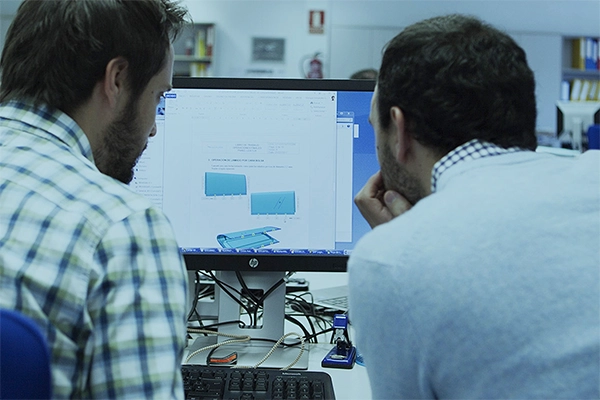
Several departments were involved: Postprocessors developed and refined a customized postprocessor for the robotic cell; CAD carried out reverse engineering and designed components for the polishing head; CAM handled testing and robot programming, initially at the customer’s facility and later remotely; and Applications developed a dedicated application for the project. The initiative required significant collaborative effort and extensive research hours.
Systems & Tools
- NX CAD/CAM (Siemens Digital Industries Software).
The Results
Surface quality was significantly improved, with substantial machine-time savings and access to polishing areas previously unreachable.
A stable and uniform polish was achieved, manual adjustment time was reduced by 65%, operator safety was improved, and up to 90% polishing coverage was reached in some references.
Additionally, on-machine adjustments and remote programming were enabled, giving the customer greater control over the process.