


28 January | 2 MIN READ
What is an MES System? Top Questions Answered with Siemens Opcenter Execution Discrete
Manufacturing environments are under constant pressure to produce more, faster, and with higher quality while maintaining full traceability and operational control. This is where Manufacturing Execution Systems (MES) play a critical role.
Yet, many manufacturers still have questions about what MES really is, how it works, and how solutions, like Opcenter Execution Discrete fit into their digitalization strategy. In this article, we answer the most common questions.
Let’s start from the beginning.
What is an MES system?
A Manufacturing Execution System (MES) is a software that manages, monitors, and controls production execution in real time. It connects planning with actual shop floor operations, ensuring that work is executed correctly, consistently, and according to defined processes, software that manages, monitors, and controls production execution in real time. It connects planning with actual shop floor operations, ensuring that work is executed correctly, consistently, and according to defined processes.
According to the widely accepted definition, an MES tracks and documents the transformation of raw materials into finished goods, providing real-time visibility into production operations.
In discrete manufacturing, an MES becomes the operational backbone that ensures every product unit follows the correct route, instructions, and quality rules.
What are the main benefits of implementing an MES?
Manufacturers typically adopt MES to solve common operational challenges such as lack of visibility, manual processes, and disconnected systems.
Key benefits include:
- Real-time production visibility
Know what is happening at any moment, not hours or days later. - Improved quality control
Digital quality checks, non-conformance handling, and root cause analysis. - Full traceability
Track materials, components, processes, and operators. - Higher productivity
Fewer manual tasks, fewer errors, faster decision-making. - Standardized processes
Enforce best practices across lines, plants, and regions.
How does an MES integrate with ERP and other systems?
An MES acts as a bridge between planning systems and the shop floor.
Typically:
- The ERP sends production orders, BOMs, and master data.
- The MES executes those orders, manages resources, and collects real-time data.
- Automation systems, PLCs, and IoT devices feed live production data into the MES.
- Quality systems, maintenance tools, and analytics platforms connect to MES for a complete operational picture.
This integration ensures that planning, execution, and reporting are aligned.
What is the difference between MES, MOM, and ERP?
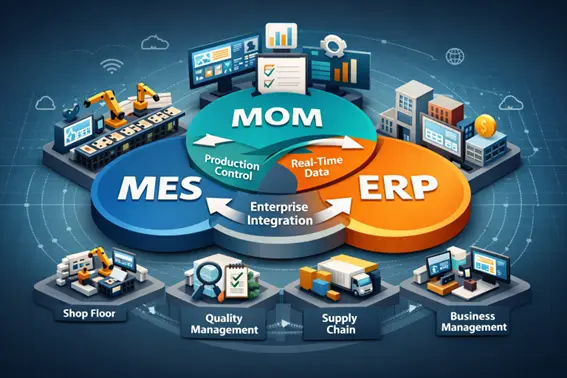
This is a very common point of confusion. Manufacturing organizations use several layers of software to manage operations, each serving a different purpose.
| System | Focus |
| ERP | Business planning, finance, procurement, HR |
| MES | Real-time production execution |
| MOM | Broader concept that includes MES and quality, maintenance, analytics, etc. |
MES focuses specifically on executing production, while MOM (Manufacturing Operations Management) is a broader framework that may include MES as a core component..
How much does a MES implementation cost and how long does it take?
There is no single answer, as it depends on:
- Number of sites
- Process complexity
- Integration requirements
- Customization level
- Rollout strategy
However, modern MES platforms like Opcenter Execution Discrete are modular, scalable, and cloud-ready, allowing companies to start small and expand over time.
Moving from a standard MES to Opcenter Execution Discrete
Now let’s focus on the more specific questions around Opcenter Execution Discrete.
How Opcenter Execution Discrete supports production execution
Opcenter Execution Discrete is a Siemens’ MES solution specifically designed for discrete manufacturing environments.
It supports the full production lifecycle:
1-Standardized execution across all shifts
- Opcenter Execution Discrete ensures that:
- Operations follow approved sequences
- Variants are handled correctly
- Routing logic is enforced
- Only valid processes are executed
This reduces variability and supports standardized production.
2-Digital and contextual work instructions
Operators no longer need to guess.
They receive:
- Step-by-step digital work instructions
- Context-aware guidance based on the product
- Built-in validations before moving forward
This improves confidence and reduces human errors.
3-Quality embedded into production
With Opcenter Execution Discrete, quality becomes part of execution.
- Checks are triggered automatically
- Deviations are detected instantly
- Non-conformities are documented in real time
This helps reduce rework and supports right-first-time manufacturing.
4-Real-time shop floor visibility
Production leaders can monitor:
- Active orders
- Bottlenecks
- Blocked stations
- Deviations
Not tomorrow. Now.
This level of visibility allows faster decisions and fewer disruptions.
5-Automatic traceability
Every product unit gets a complete digital history:
- Operations performed
- Operators involved
- Components used
- Timestamps
This traceability is created automatically, without extra administrative work.
What industries are Opcenter Execution Discrete best suited for?
Opcenter Execution Discrete is ideal for industries with complex assembly, variant-rich products, and strict traceability requirements, such as:
- Automotive
- Industrial machinery
- Electronics
- Aerospace
- Medical devices
- High-tech equipment
These industries require high flexibility, frequent product changes, and strong compliance.
Why is Opcenter Execution Discrete aligned with industry trends?
Opcenter Execution Discrete aligns with modern manufacturing trends by providing real-time operational visibility, integrating production with ERP and PLM systems, and ensuring quality, traceability, and process synchronization.
Gartner highlights in the Gartner Magic Quadrant for Manufacturing Execution Systems (MES) report, the importance of solutions like Opcenter Execution Discrete in smart, data-driven manufacturing.
Its support for digital thread strategies, scalability, and IoT integration ensures manufacturers can meet Industry 4.0 demands efficiently.
Why ATS Global and Opcenter Execution Discrete
Technology alone is not enough.
What makes the difference is how it is implemented on the shop floor.
ATS Global is a certified Siemens partner, with extensive experience implementing Opcenter Execution Discrete across discrete manufacturing industries. Our expertise ensures seamless integration, real-time visibility, and maximum operational efficiency.
At ATS Global, we focus on:
- Real production workflows
- Practical deployment
- Phased rollout
- Measurable results
- Long-term scalability
Not disruption.
Real improvement.
Frequently Asked Questions (FAQ)
👉 Want to see how Opcenter Execution Discrete can improve your shop floor control?