

Data Centre
How to prepare your data centre for EED reporting
Learn why PUE alone is no longer enough and how integrated data center operations can support EED sustainability reporting across Europe.

Martin Matse | July 15, 2026 | 2-minute read
PUE is no longer enough: prepare your data centre for EED reporting
For years, Power Usage Effectiveness (PUE) was the industry’s default measure of data centre performance. It answered a simple, useful question: how much of the energy entering your facility reaches IT equipment, and how much is lost to cooling, power distribution and other facility systems?
But the landscape has shifted, and so have expectations.
Under the revised Energy Efficiency Directive (EED), data centre operators in Europe now face mandatory sustainability reporting obligations introduced by the European Commission.
These legal requirements, which are neither voluntary benchmarks nor best-practice frameworks, are submitted annually to a European database and cover a wider set of metrics than PUE alone.
At the same time, standards such as EN 50600, which define how efficiency and sustainability should be structured and measured, are still evolving.
The result is an unusual situation: reporting obligations are active now, while some of the frameworks to support them are still maturing. That gap is where many operators are struggling.
Measuring data centre sustainability beyond PUE
PUE remains a useful indicator. A low PUE tells you that your facility infrastructure is consuming relatively little energy on top of what the IT equipment needs. That still matters, and it can still help reduce operating costs.
But PUE doesn’t tell the full story.
It says nothing about water consumption, carbon impact, waste heat reuse, renewable energy sourcing or IT equipment efficiency. And under the EU’s Delegated Regulation 2024/1364, these are exactly the kinds of metrics operators are now expected to report.
Key KPIs defined under ISO/IEC 30134 and referenced by the EED include:
- PUE, Power Usage Effectiveness
- WUE, Water Usage Effectiveness
- ERF, Energy Reuse Factor
- REF, Renewable Energy Factor
- CER, Cooling Efficiency Ratio
- CUE, Carbon Usage Effectiveness
- IT load data, data volumes, installed power and floor area
The EED’s reporting framework specifies which indicators are mandatory for annual reporting. Not all the above are currently required in the same way, but the direction: operators who measure broadly will be better positioned as requirements evolve.
The shift is significant. PUE answered one question: how efficiently is power used? The region’s emerging frameworks ask a broader one: can your data center measure, explain and account for its total operational impact?
The shift is significant. PUE answered one question: how efficiently is power used? The EED asks a broader one: can your data centre measure, explain and account for its total operational impact?
What is driving mandatory sustainability reporting in data centres
Two forces are converging.
First, data centre energy demand is growing rapidly. The International Energy Agency projects global data centre electricity consumption to more than double by 2030. This will be driven by AI workloads, cloud migration and compute-intensive infrastructure expansion. That growth has put data centres firmly in the sights of regulators and policymakers.
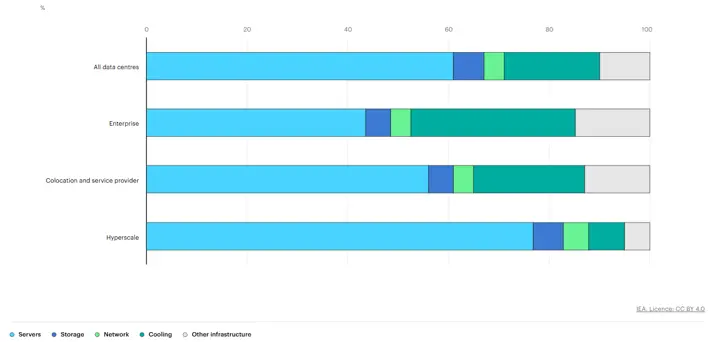
Share of electricity consumption by data centre and equipment type, 2024
Second, sustainability performance is now a business requirement, not just a compliance checkbox. It’s increasingly influencing investment decisions, public procurement eligibility and customer due diligence. Non-compliance with EED requirements can create commercial risk for operators that need to demonstrate transparency, efficiency and environmental accountability.
The combined effect is clear: energy transparency is no longer optional. Instead, it’s a must-have to compete in the European data centre market.
Fragmented energy data: the real EED reporting challenge
The biggest obstacle for most operators isn’t a lack of data. It’s that the data is fragmented.
Most facilities already generate large volumes of operational information from DCIM platforms, BMS, EMS, CMS, real-time monitoring and control systems, metres and cooling infrastructure. The problem is that these sources rarely talk to each other.
Data sits in separate platforms, calculated using inconsistent methods and often extracted manually for reports.
This creates real risks:
- Inconsistent figures across reporting periods
- Limited traceability when auditors ask questions
- Manual effort and spreadsheet dependency at scale
- Delayed visibility into inefficiencies
- Difficulty correlating IT load, cooling behaviour and energy consumption
- Inability to demonstrate performance reliably under scrutiny
Compliance requires more than collecting figures. It requires a consistent data layer, one that connects energy, infrastructure and operational context in a way that can be verified and reported with confidence.
How to prepare your data centre for EED reporting
The good news is that most operators don’t need to replace their existing systems. The more effective approach is to integrate what’s already in place and create a unified operational data layer on top of it.
A practical roadmap looks like this:
- Map your existing data sources
Identify where energy, cooling, water, carbon, capacity and IT load data currently live, and where the gaps exist. - Define your reporting metrics and calculation logic
Align PUE, WUE, ERF, REF, CER, CUE and other KPIs with EED requirements. Establish consistent definitions across sites and systems. - Connect IT and OT data
Link infrastructure performance with operational behaviour. Static facility data alone isn’t enough. You need to understand how load, cooling and energy interact in real time. - Automate data collection and reporting
Reduce manual effort and improve consistency. Automated pipelines reduce error risk and make annual reporting more reproducible. - Create real-time visibility
Detect deviations as they happen rather than discovering them in monthly or annual summaries. - Use energy data for continuous improvement
Compliance data doesn’t have to be a dead end. When structured correctly, the same data can inform better cooling strategies, load balancing, asset performance and resource efficiency.
This is the shift from reporting as a burden to reporting as an operational advantage.
How integrated DCIM supports EED compliance
Modern Data Center Infrastructure Management (DCIM) platforms are becoming central to energy transparency, but their role has evolved.
Historically, infrastructure management tools were used primarily to monitor power, building systems, cooling equipment and critical operational variables. Today, a well-implemented DCIM platform can go further: connecting systems, structuring operational data, automating KPI calculation and providing the audit trail that regulatory reporting requires. Read about the Switch Data centers here.
ATS Data Center Solutions takes a modular approach to data centre management, covering building management, cooling, capacity, energy and billing. That modularity matters because most operators can’t or don’t want to replace everything at once.
The ability to connect existing systems and extend capabilities step by step is what makes compliance achievable in practice.
An integrated DCIM and operations platform can support:
- Centralised energy data collection across systems
- Power and cooling performance monitoring
- Capacity and infrastructure asset visibility
- EED KPI calculation and reporting
- Single-site and multi-site performance comparison
- Operational dashboards for facility and management teams
- A more reliable audit trail for sustainability reporting
But visibility alone is not always sufficient.
Why BMS, EMS and CMS matter for real-time energy control
Visibility tells you what’s happening. Control determines what you do about it.
If your operations platform flags rising energy consumption, teams still need to understand the cause and act on it. That may involve cooling adjustments, load balancing, equipment sequencing, alarm handling or integration with building automation.
This is where EMS, BMS and CMS layers become essential. They translate operational visibility into real-time control and action.
EMS helps teams understand and optimise energy performance. BMS connects building systems and environmental conditions. CMS provides visibility into critical infrastructure and operational status. Together, they help data centre teams move from passive monitoring to active optimisation.
Built on a real-time integration platform like Ignition from Inductive Automation, ATS Data Center Solutions connects EMS, BMS and CMS into a single operational view, giving teams both the visibility and the control to act on what the data reveals.
Together, they provide:
- Real-time energy visibility with operational context
- Automated alerts and escalation paths
- Faster incident response
- More accurate correlation between facility conditions and energy use
- Consistent, reproducible reporting
- A feedback loop for continuous performance improvement
From regulatory obligation to operational advantage
The operators who’ll benefit most from the EED aren’t those who treat it as a reporting exercise. They’re the ones who use it as a trigger to build a stronger operational data foundation.
When energy data is structured, connected and available in context, the same information required for compliance can also identify hidden inefficiencies, reduce costs, improve cooling strategies and strengthen customer confidence.
The question isn’t just: how do we comply with the regulation?
The more valuable question is: how do we use energy data to run a better data centre?
From PUE to proof: verifiable sustainability in data centres
The shift happening in the data centre industry is not simply about adding more metrics. It is about moving from informal efficiency practices to verified, auditable sustainability performance.
PUE was a starting point. The EED marks a new baseline, one where energy transparency, water use, waste heat recovery and renewable sourcing all form part of how a data centre is evaluated, regulated and trusted.
The operators best positioned for what comes next are those building the data infrastructure to meet it, not just for this year’s reporting deadline, but for the ones that follow.
Frequently Asked Questions
Ready to turn sustainability reporting into operational advantage?
Discover how ATS Data Center Solutions can connect energy, cooling and infrastructure data for reliable, audit-ready reporting.